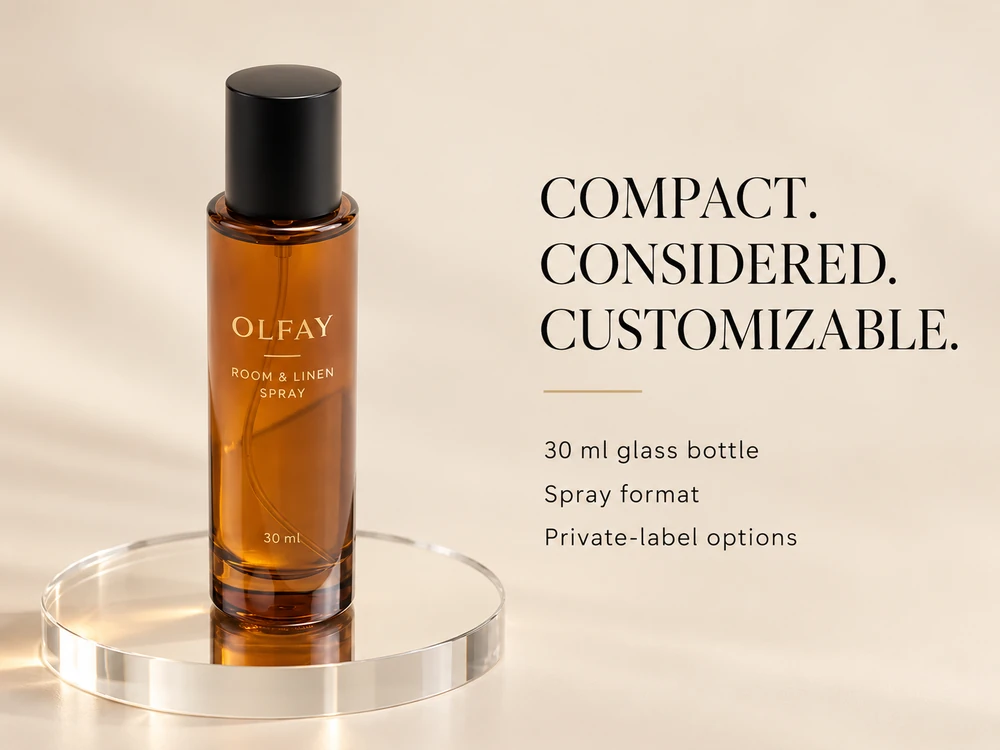
For a home fragrance brand, linen spray offers a different customer interaction from a candle or reed diffuser: a controlled application to an approved textile. That interaction should guide the formulation, bottle and instructions.
Define Where the Spray Will Be Used
Decide whether the product is intended for bedding, selected upholstery, curtains or another specified textile category. Define exclusions as carefully as inclusions. A product approved for one washable fabric should not automatically be described as suitable for leather, silk or every upholstered surface.
If you want both air and fabric use, ask the developer to evaluate both applications. “Room and linen spray” is an intended-use claim, not simply a longer product name.
Fragrance Should Suit Close-Range Use
Textiles may be experienced at a shorter distance than room diffusion. A scent that feels balanced in a large space can seem intrusive on a pillow or garment. Compare the initial application and the dry textile at defined intervals.
Use specific sensory language: soft floral, dry linen-like, citrus-green or gentle woody. Avoid promising better sleep or a therapeutic benefit merely because a scent is associated with a bedtime ritual.
Our fragrance accords guide can help describe the creative direction without confusing sensory impressions with product claims.
Fabric Compatibility Needs Representative Testing
| Check | What to observe |
|---|---|
| Appearance after application | Rings, darkening, droplets or uneven wetting |
| Appearance after drying | Staining, color change or visible residue |
| Feel | Changes to handle or tackiness |
| Repeated use | Effects that become visible after several applications |
| Scent | Character and intensity on the intended fabric |
Use representative fabrics and colors rather than a single white swatch. Test with the intended nozzle, distance and amount. Keep untreated comparison pieces and photographs so subtle changes are easier to assess.
A hidden-area trial is useful customer advice where appropriate, but it does not replace the brand’s own compatibility evaluation. Do not use that sentence to justify an untested universal fabric claim.
The Bottle Is Part of the Experience
Assess spray pattern, output, dripping, priming and closure performance with the actual formula. An overly wet jet can create a different fabric result from the fine distribution expected in the brief.
Check whether the bottle and pump tolerate the liquid during storage and normal use. Evaluate leakage and label durability as well as fragrance. A beautiful bottle that dispenses inconsistently makes instructions difficult to follow.
Avoid Unsupported Cleaning Claims
A pleasant smell does not demonstrate antimicrobial performance, allergen removal or elimination of the cause of an odor. Such claims require evidence and can change the product’s regulatory treatment.
Describe the actual fragrance function and permitted uses. Do not imply that fresh-smelling bedding is hygienically treated or that the spray replaces cleaning. Keep room-fragrance instructions separate from skin or cosmetic uses.
Build an Approval File
- Formula identity and agreed fragrance code.
- Intended textiles, exclusions and use conditions.
- Stability and relevant microbiological assessment.
- Bottle, pump and compatibility observations.
- Fabric results and sensory evaluation.
- Approved label wording and sample reference.
The developer should determine the appropriate assessment for the formulation. Adding essential oils or using a plant-derived ingredient does not establish preservation or finished-product stability.
Frequently Asked Questions
Is linen spray the same as room spray?
Some products support both uses. Others do not. Follow the instructions for the exact product.
Can linen spray be used on every fabric?
No universal compatibility should be assumed. Check the product’s intended surfaces and instructions.
Does linen spray sanitize bedding?
Only make that claim if the exact product has suitable evidence and meets relevant requirements.
Is it a body spray?
Not unless it is specifically developed and labeled for that use. Textile fragrance and skin products require different assessments.
Explore OLFAY home fragrance products and share your intended fabrics and scent brief to discuss a suitable spray project.
Further Reading
Developing a Private Label Fragrance Product?
Talk with our team about fragrance development, packaging and production requirements.